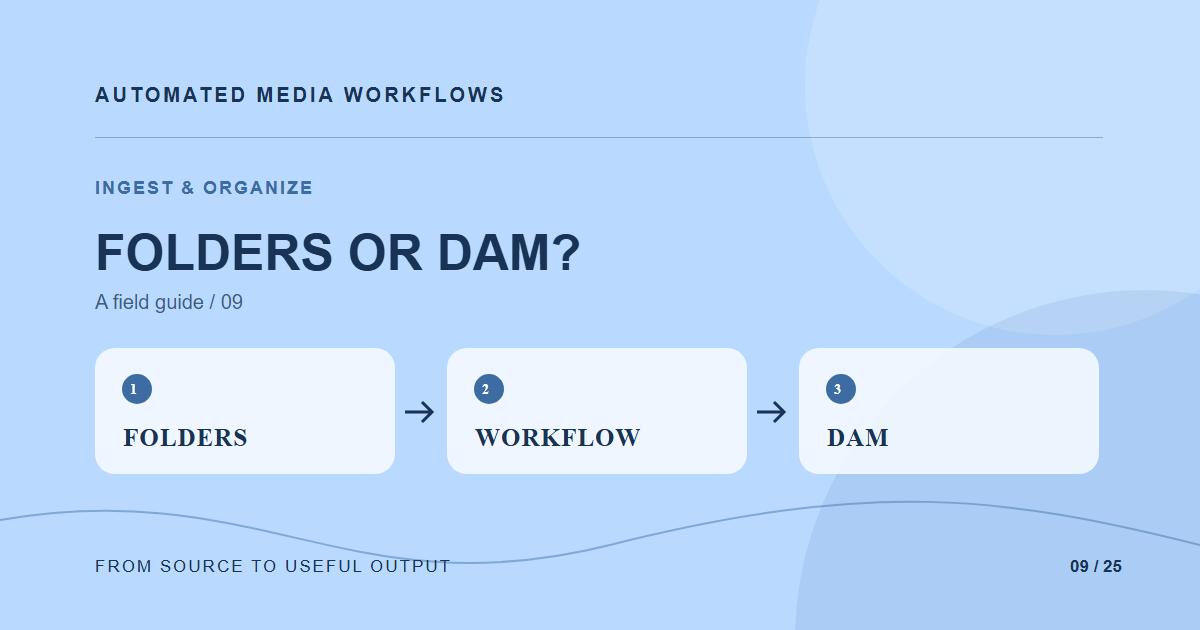
Folders work when a small group knows where files live and the main task is storage. A digital asset management system becomes useful when teams must find, approve, reuse, transform, or restrict assets across many channels. The deciding issue is usually workflow complexity, not the number of files alone.
Where folders work well
A project folder can be simple, cheap, and easy to understand. It is suitable when one owner controls the files, rights are straightforward, and publication is a manual, low-volume task. Keep a naming rule and a backup anyway. Do not buy a platform to solve a process nobody has described.
What changes the equation?
Look for repeated searches, duplicate uploads, uncertain usage rights, manual variant creation, and “which is approved?” messages. If those problems consume more time than the team can tolerate, you need structured metadata and states. A DAM may provide these in one place, but integrations and adoption still matter.
Run a real comparison
Choose three everyday tasks: find the approved hero, make channel variants, and remove an expired asset from public use. Time them in the current folder setup and in a trial workflow. Include the person who uploads and the person who publishes. A platform that helps only the administrator will not solve the handoff.
Plan migration honestly
Old files may lack reliable rights or ownership data. Import them into a review state rather than marking everything approved. Preserve original IDs or a mapping table so existing URLs and content references can be reconciled.
A concrete example
A six-person team can locate its thirty campaign files quickly in a shared folder. It does not need a DAM for storage alone. If the same team starts sending variants to five storefronts and cannot trace approval or license status, test a structured library against those tasks before choosing software.
Related reading
- Media Workflow Automation: A Practical Starting Guide
- Media Upload Validation: What to Check Before Processing
- Migrate to a Media Pipeline Without Losing Asset History
Primary reference
The Cloudinary DAM documentation provides the underlying technical reference for this workflow.