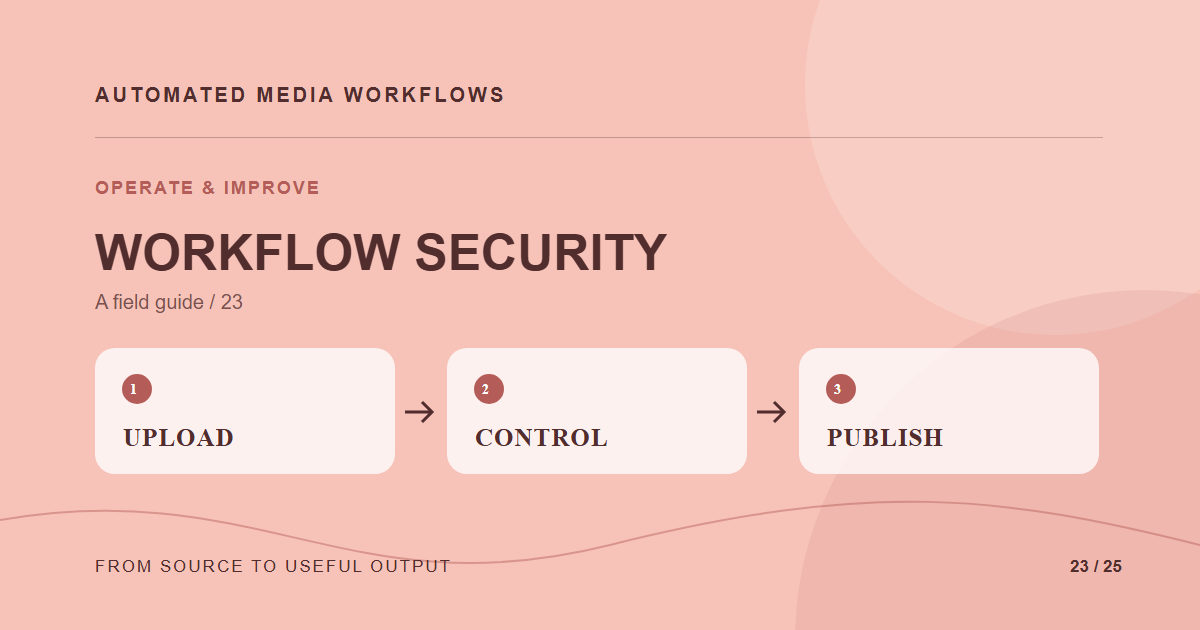
A media workflow crosses trust boundaries: uploaders submit files, processors read them, reviewers authorize use, and delivery systems publish results. Security controls should follow those boundaries. A private original is not protected merely because its public derivative has a different URL.
Limit access by task
Give upload, review, transformation, and publication identities only the permissions they need. Separate private originals from public derivatives. Rotate integration credentials and avoid embedding them in asset metadata or transformation URLs. Record who changed approval and rights fields.
Treat files as untrusted
Validate formats and resource limits before expensive processing. Keep unreviewed files out of public buckets or CDNs. Use trusted parsers and update them. Consider how metadata, embedded scripts, or malformed files could affect downstream viewers and tools.
Protect rights decisions
Store license scope, expiry, and territory where they matter. A derivative should inherit the source restrictions unless a reviewer explicitly changes them. If rights expire, the workflow needs a way to find and unpublish every active placement, including cached pages and scheduled posts.
Rehearse a removal
Pick a test asset and trace every output and public URL. Revoke its approval, remove or replace references, invalidate caches, and confirm that old links no longer expose it where they should not. This exercise reveals blind spots that a permissions checklist cannot.
A concrete example
A contractor may upload campaign files but should not approve public use. A processor can read a private original and write derivatives, while a delivery service can read only approved public outputs. Rehearsing a rights revocation shows whether those boundaries and cache controls actually protect the asset.
Related reading
- Media Workflow Automation: A Practical Starting Guide
- Make Media Webhooks Idempotent and Safe to Retry
- Build vs Buy Media Automation: A Decision Framework
Primary reference
The OWASP file upload guidance provides the underlying technical reference for this workflow.